ch1.the_big_cycle_in_a_tiny_nutshell
Ch 1. THE BIG CYCLE IN A TINY NUTSHELL
History moves in recurring large-scale cycles of wealth, power, and societal structure, which can be studied to understand present and future shifts in global order.
Primary Purpose
- To present a distilled, archetypal model of the rise and fall of empires and the underlying cycles that drive them.
Key Structural Points
-
Historical Patterns and Archetype
- The author identifies patterns in the histories of major empires over the past 500 years.
- These patterns are used to build an archetype—a generalized model—to understand recurring dynamics.
-
Current Relevance
- A major shift in world order is occurring now, akin to past transformations.
- This shift is not widely recognized because people often lack historical context.
-
Methodology
- The insights are based on extensive historical study, interviews with experts, archival research, and financial experience.
- The process is iterative and involves continuous refinement and validation.
Underlying Mechanisms
-
Three Major Cycles
- Long-term debt and capital markets cycle.
- Internal order and disorder (civil unrest and governance).
- External order and disorder (geopolitical conflict).
-
Causal Dynamics
- Wealth and power concentrate, leading to overextension.
- Economic hardship hits the least powerful hardest, leading to societal conflict.
- These conflicts reset the system, initiating a new cycle.
-
Power and Wealth Symbiosis
- Elites controlling wealth and those wielding political power form mutually reinforcing alliances.
- This relationship persists despite evolving forms (from feudal to capitalist societies).
Broader Implications
- These cycles affect not just economics and politics but ripple through culture, social values, and ideology.
- Recognizing the consistency of these cycles offers perspective on contemporary events.
Human Nature as a Constant
- Cycles persist because human emotions and behaviors—fear, greed, ambition—remain fundamentally unchanged over time.
- Like human life cycles, societal cycles follow predictable patterns despite surface variations.
Human history is driven by the interplay of evolution (long-term, progressive improvement) and cycles (shorter-term, oscillating dynamics), forming a corkscrew-like pattern of upward movement marked by recurring disruptions.
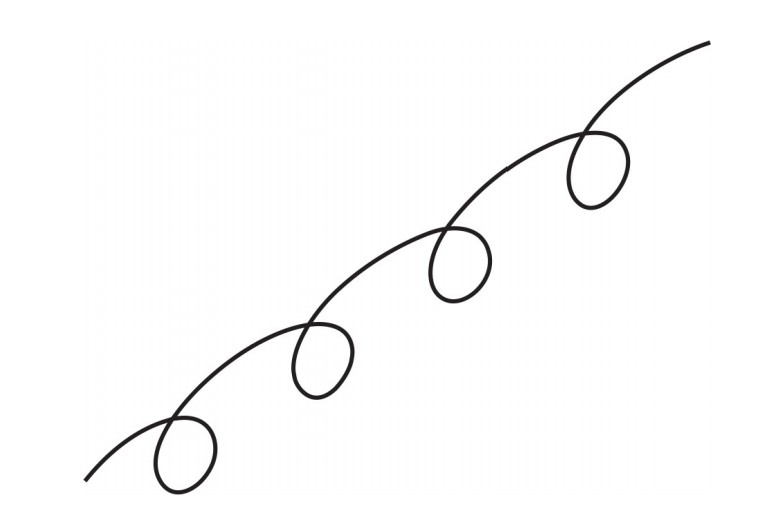
Primary Concepts
-
Evolution as a Fundamental Force
- Evolution is constant, yet often invisible without tools to measure change.
- It represents adaptation and learning over time, leading to sustained improvement.
-
Cyclicality Within Evolution
- Cycles reflect temporary reversals and extremes (e.g., economic booms and busts).
- These are driven by imbalances and overreactions (like debt accumulation).
- Painful corrections are part of the learning and adaptation process.
Mechanics of Progress
-
Human Productivity as a Key Driver
- Long-term growth in wealth, power, and living standards stems from productivity.
- Productivity improves due to education, inventiveness, and effective systems.
-
Uneven but Understandable Progress
- Though gains are not evenly distributed, the reasons behind different growth rates are identifiable and policy-relevant.
-
The Role of Human Intelligence
- Humans excel at abstract thinking and invention, which accelerates evolutionary improvement.
- This leads to continuous technological, economic, and societal change.
Historical Shifts in Wealth and Power
-
From Agrarian to Industrial to Digital Economies
- Power shifted from landowning elites to industrial capitalists, and now toward those controlling digital data and information.
- Each stage involved collaboration between economic and political elites.
-
Key Inflection Points
- The invention of the printing press enabled broader education and spurred key intellectual and technological revolutions.
- These developments led to capitalism and industrialization, reshaping global power dynamics.
Empirical Evidence and Interpretation
-
Macro Trends
- Charts of GDP per capita and life expectancy over 500 years show strong upward trends with smaller cyclical fluctuations.
- These confirm the dominance of evolutionary gains over cyclical volatility.
-
Acceleration Since the 19th Century
- Steeper gains reflect compounding effects of knowledge diffusion and productivity growth since industrialization.
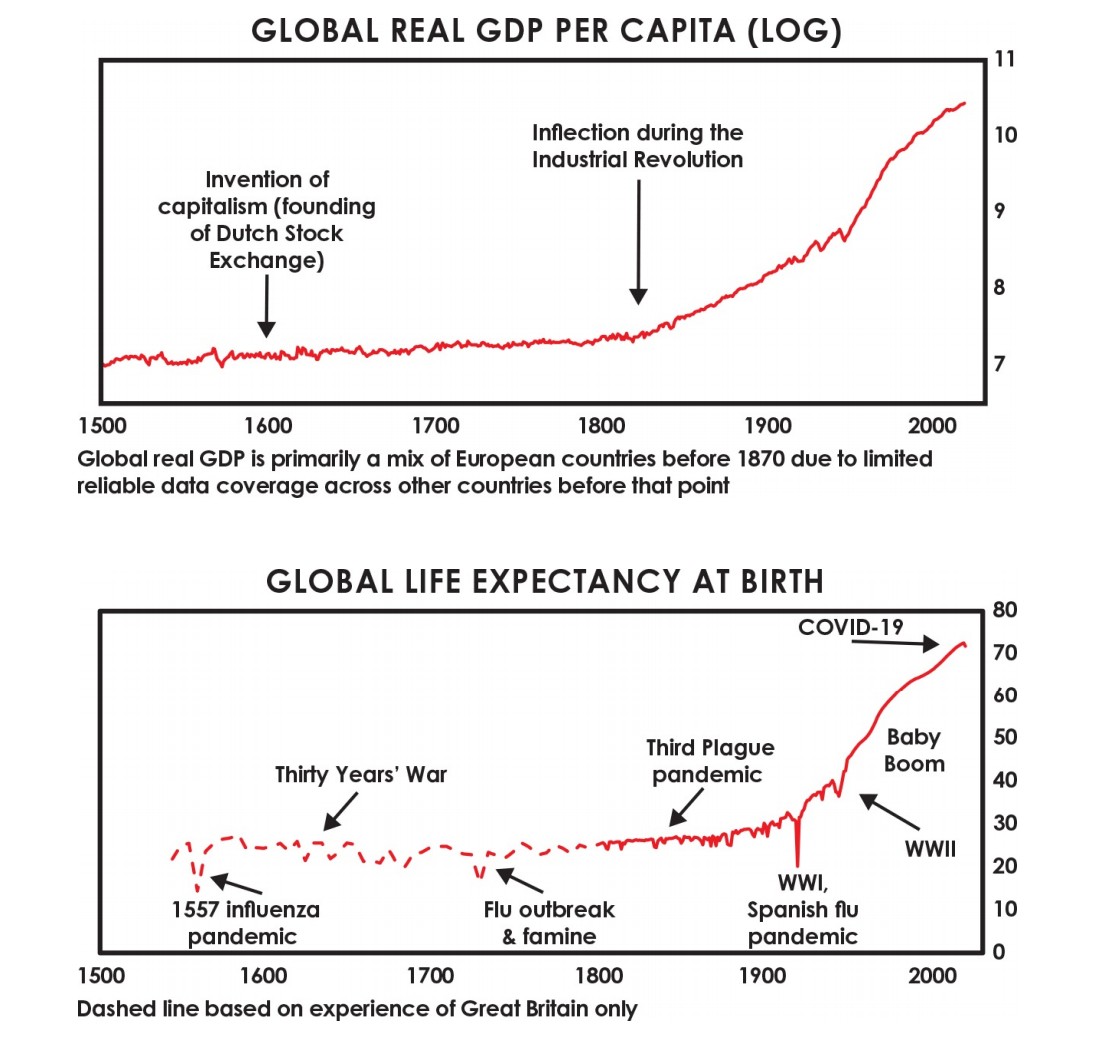
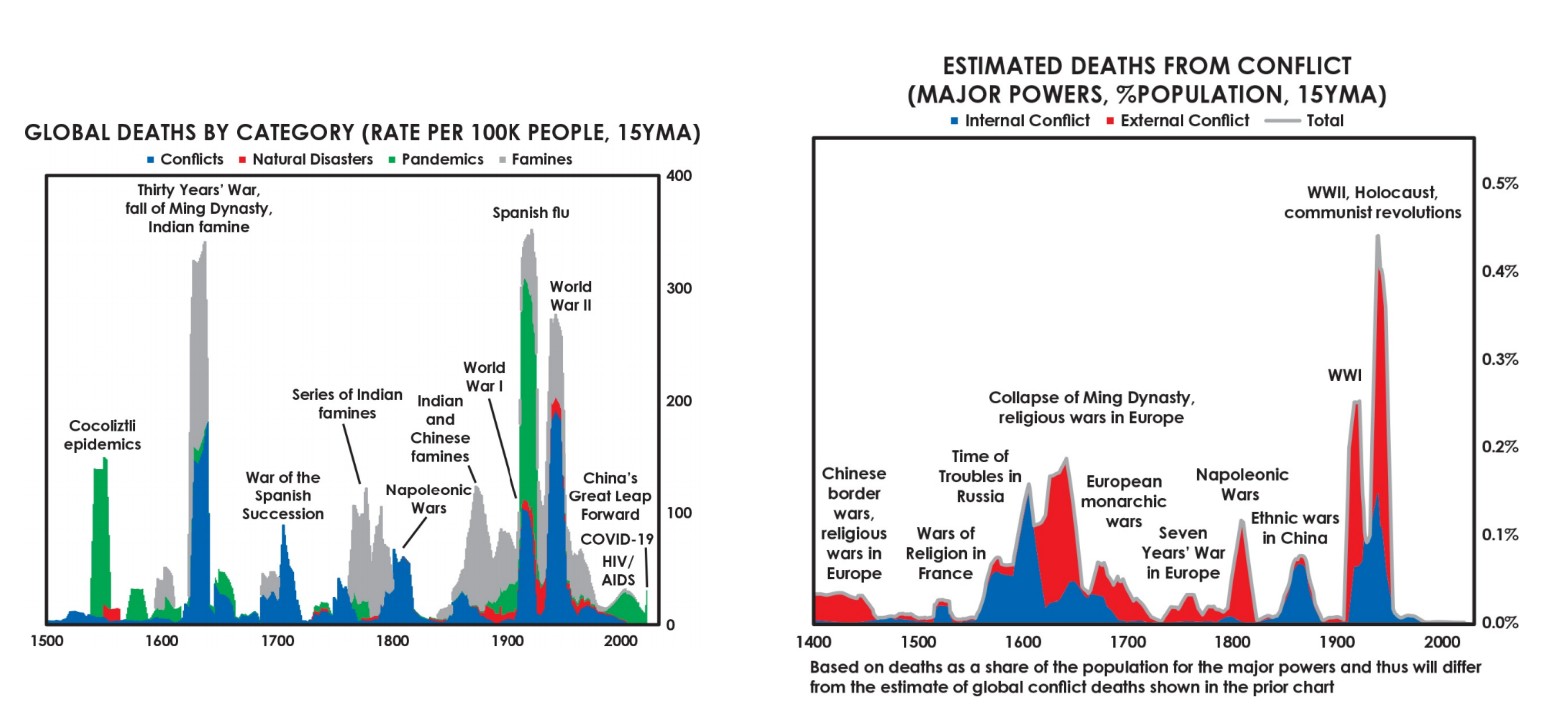
The major disruptions in history—booms, busts, revolutions, and wars—are cyclical and arise from logical cause-effect mechanisms around the longer-term trend of human evolutionary progress.
High-Level Concepts
-
Cycles vs. Evolution
- Evolution is a slow, consistent upward trend driven by learning and adaptation.
- Cycles cause abrupt shifts in wealth and power, often producing major societal upheavals.
-
Mechanisms of Cycles
- Cycles are driven by predictable dynamics like debt accumulation, wealth gaps, and economic bubbles.
- These often culminate in financial collapses, social unrest, and armed conflict.
Historical Patterns and Examples
-
20th Century Case Study
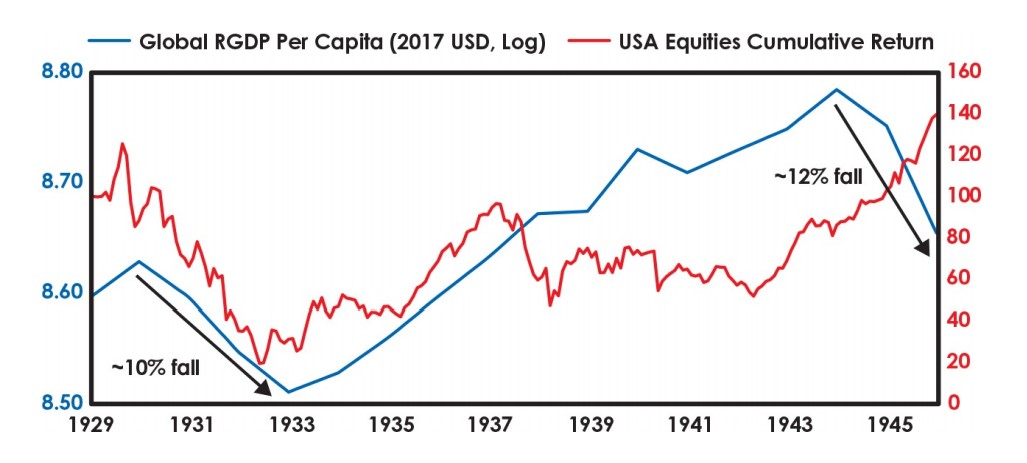
- The 1920s debt-fueled boom led to the 1929 crash and the 1930–45 depression/war cycle.
- Central banks and governments responded with debt monetization and massive interventions.
- Conflicts over systems (capitalism vs. communism, democracy vs. autocracy) intensified.
- World War II and the Great Depression caused destruction, followed by renewal and a new global order.
-
Earlier Cycles
- The 1907–19 cycle followed a similar arc: boom, bust, inequality, war (WWI), and restructuring.
- The Spanish flu and the Treaty of Versailles marked the end of this cycle, which fed into the next one.
-
Post-Crisis Rebuilding
- After crises, dominant powers emerge stronger, establishing new systems and extended periods of peace and prosperity—until overextension triggers the next cycle.
Recurring Dynamics
-
Crisis Drivers
- Economic inequality, excessive debt, and external shocks (like pandemics or droughts).
- Weak systems and leadership exacerbate crises; strong reserves and institutions mitigate them.
-
Outcomes and Adaptation
- Crises often produce major redistributions of wealth and power.
- They also spark innovation, build resilience, and renew societal structures.
Human Experience and Resilience
-
Impact on Individuals
- Destruction/reconstruction periods involve widespread suffering, but most people endure.
- Hard times can foster unity, strength of character, and new perspectives.
-
Enduring Optimism
- Despite severe disruptions, humanity’s capacity to adapt and progress consistently prevails.
- Trusting in long-term inventiveness and problem-solving is key to navigating turbulent times.
The global distribution of wealth and power has continually shifted among major empires over time, driven by economic and geopolitical dynamics, with dominant powers rising and falling in recognizable patterns.
Main Themes
-
Nature of Global Power Transitions
- Throughout history, groups (tribes, kingdoms, nations) have become dominant by creating, acquiring, or extracting wealth.
- When a group surpasses others, it defines the global order until decline sets in, prompting a systemic reshuffling.
-
Visualization of Power Shifts
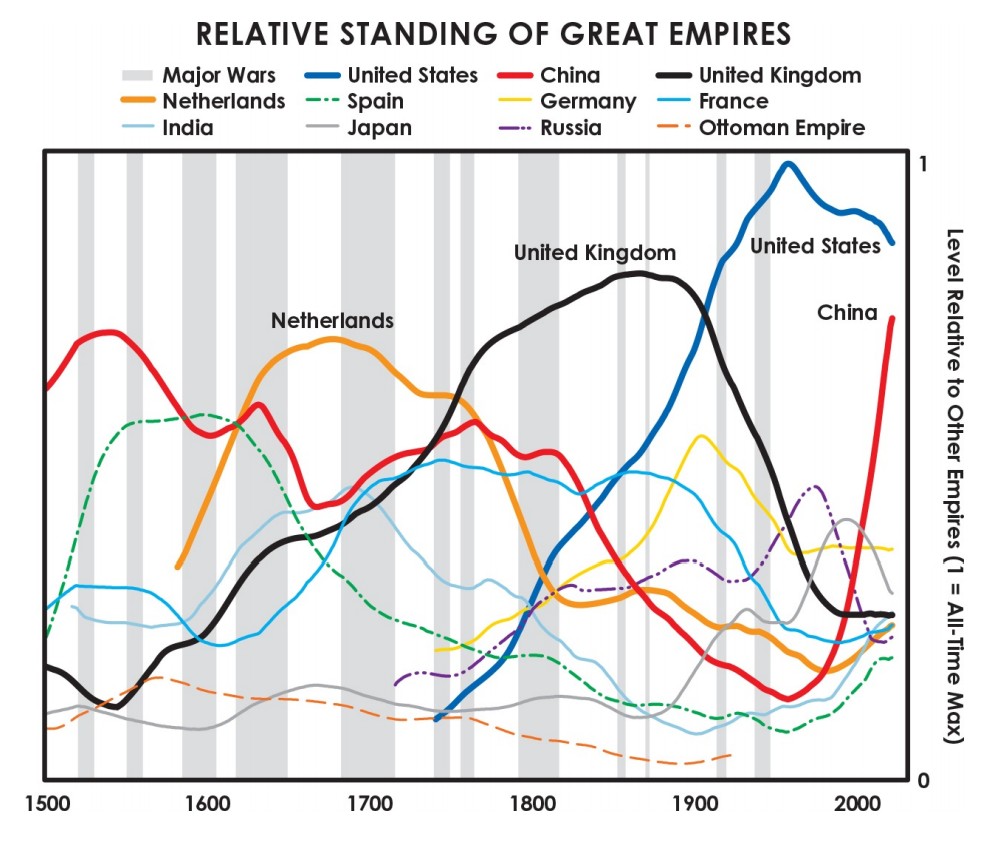
- A chart of 11 leading empires over the past 500 years shows cycles of ascendancy and decline.
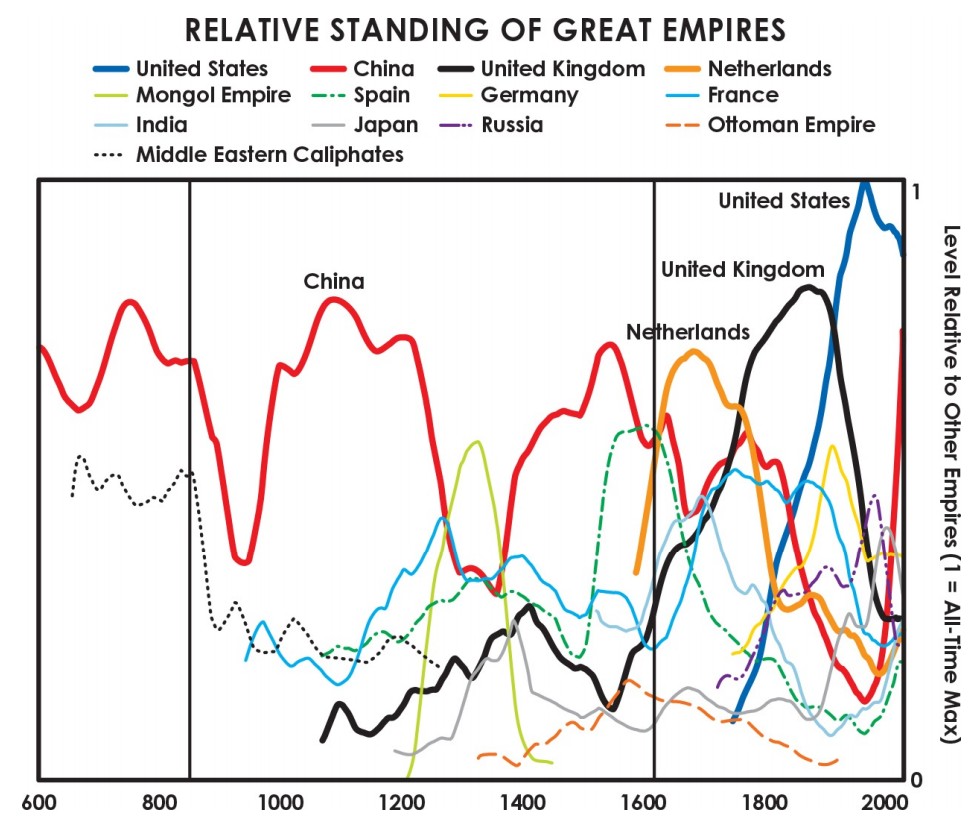
- A longer chart traces these dynamics back to the year 600.
Key Historical Trends
-
Four Major Empires
- China: Longstanding global leader until the 1800s; currently resurging.
- Netherlands: Rose in the 1600s as a trading and reserve currency empire.
- United Kingdom: Peaked in the 1800s, inheriting global dominance from the Dutch.
- United States: Rose rapidly over the last 150 years, peaking post-WWII; now in relative decline.
-
Other Historical Powers
- Earlier cycles included influential powers like the Mongols, Middle Eastern caliphates, French, Spanish, and Ottomans.
Nuanced Observations
-
Wealth/Power ≠ Well-being
- Wealth and power are not synonymous with quality of life or happiness.
- Some countries prioritized peace and life satisfaction over expansion and dominance.
-
Excluded "Boutique" Nations
- Smaller yet prosperous nations like Switzerland and Singapore are not included due to their scale, though they rank high in living standards.
Implication
- Understanding these cyclical shifts in dominant powers provides context for interpreting current geopolitical trends and anticipating future transitions.
The rise and fall of empires follow a predictable, cyclical progression driven by a set of interrelated determinants of national strength.
Key Concept: The "Big Cycle"
- Empires ascend and decline based on a sequence of mutually reinforcing strengths.
- These strengths typically rise and fall together in a consistent order over time.
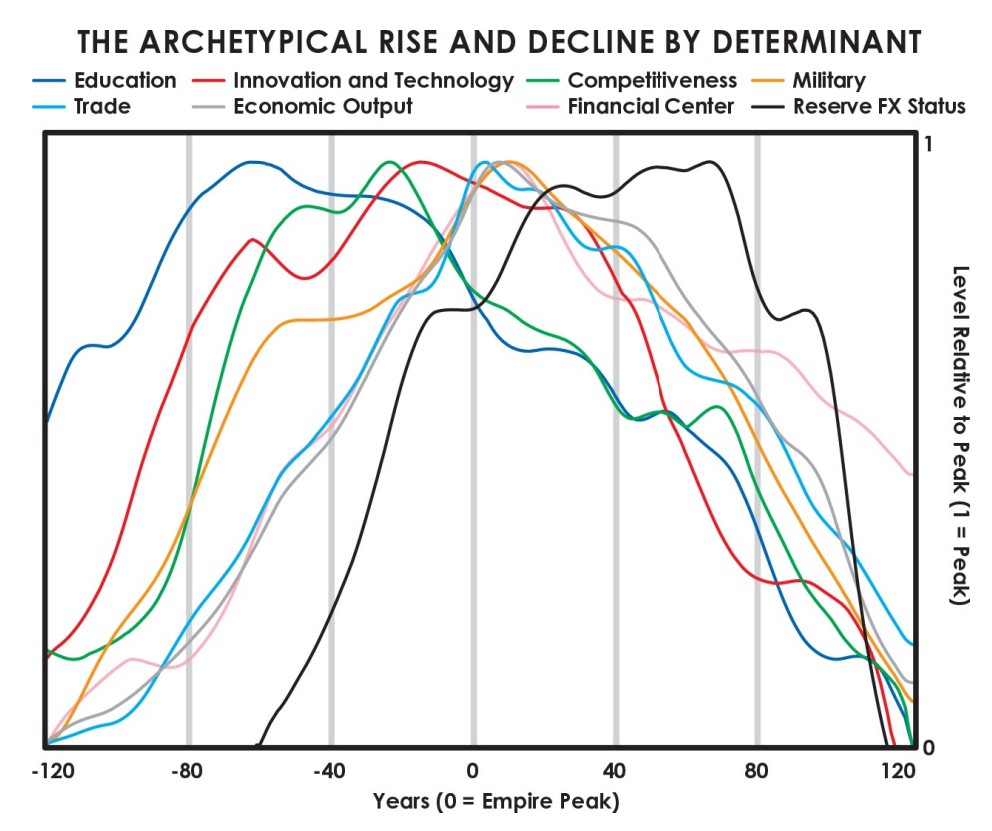
Eight Core Determinants of Wealth and Power
-
Education
- Foundation for other strengths; enables skill development and knowledge growth.
-
Competitiveness
- Ability to thrive economically and innovate relative to other nations.
-
Innovation and Technology
- Drives productivity, military strength, and industrial leadership.
-
Economic Output
- Reflects the total production power and wealth of a nation.
-
Share of World Trade
- Indicates global economic integration and influence.
-
Military Strength
- Ensures security and projection of power internationally.
-
Financial Center Strength
- Attracts global capital and enhances economic dominance.
-
Reserve Currency Status
- Confers financial advantages and sustains influence even after decline begins.
Structural Dynamics
-
Strengths tend to:
- Build sequentially (e.g., education → innovation → trade → reserve currency).
- Decline in reverse order as systemic weaknesses emerge.
-
These indicators form a reinforcing cycle, where strength in one supports others.
Durability of Reserve Currency
- Reserve currencies persist beyond an empire's peak due to habitual global use, mirroring the inertia of dominant languages.
The rise and fall of empires follow a recurring three-phase pattern called the Archetypical Big Cycle, encompassing ascent, peak, and decline before renewal.
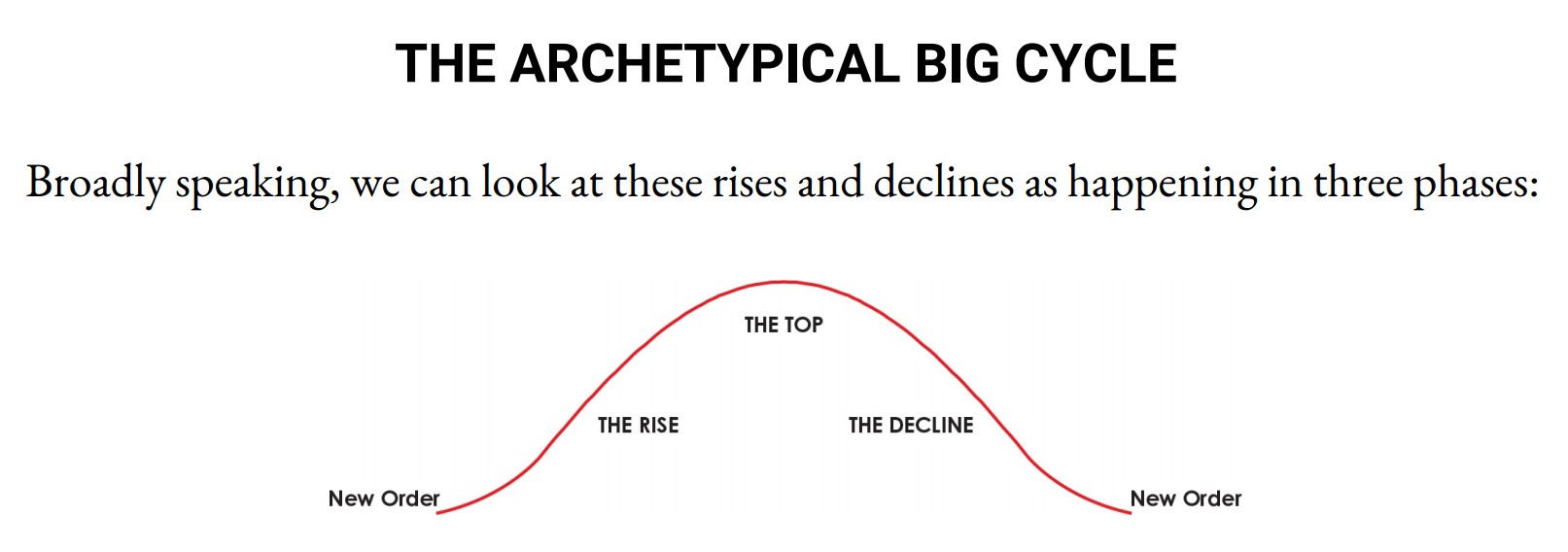
Three Phases of the Big Cycle
-
The Rise (Foundation and Growth)
-
A new order emerges following restructuring and conflict.
-
Key features:
- Low debt levels.
- Narrow wealth, values, and political gaps.
- Cooperative and productive society.
- Strong education and infrastructure.
- Effective leadership.
- Stable and peaceful global environment, typically led by dominant powers.
-
-
The Top (Peak and Overextension)
-
Period of prosperity evolves into excess and internal strain.
-
Key features:
- High indebtedness.
- Widening social, political, and economic divides.
- Declining education and infrastructure quality.
- Increasing internal class conflict.
- Heightening external rivalries challenging dominant empires.
-
-
The Decline (Disorder and Reset)
-
Crisis phase characterized by internal and external conflict, economic pain, and systemic change.
-
Key outcomes:
- Major disruptions lead to a reshaping of the world order.
- This chaos eventually gives way to a new beginning and another rise.
-
Implication
- These phases are sequential and cyclical, illustrating how empires grow strong, become complacent and divided, then decline, paving the way for renewal.
- The Rise phase of an empire follows a consistent pattern of strengthening leadership, societal values, innovation, productivity, global trade, and financial infrastructure—culminating in world power and reserve currency status.
Key Elements of the Rise
-
Foundational Leadership and Governance
- Strong, capable leaders establish effective systems that promote national wealth and power.
- These systems prioritize long-term development, institutional integrity, and societal order.
-
Education and Social Values
- Emphasis on both intellectual and moral education (e.g., character, civility, work ethic).
- Results in lawfulness, low corruption, and cooperative, productive citizens.
-
Innovation and Openness
- Societies that innovate—especially technologically—gain competitive advantages.
- Being open to global knowledge and practices enhances innovation further.
-
Coordination Across Sectors
- Effective collaboration among workers, government, and military strengthens internal unity and output.
Economic and Global Expansion
-
Increased Productivity and Competitiveness
- Education and innovation lead to greater economic output and a larger share of global trade.
-
Military Growth
- As global trade expands, military capability is developed to protect trade routes and foreign interests.
-
Reinvestment into National Development
- Rising income is used to fund infrastructure, education, and R&D, reinforcing the growth loop.
Capitalism and Financial Infrastructure
-
Incentivization of Wealth Creation
- Capitalist systems (including state capitalism) reward entrepreneurship and economic contribution.
- Financial markets convert savings into productive investment.
-
Development of Financial Centers
- Dominant empires establish the world’s leading financial hubs (Amsterdam → London → New York → Shanghai rising).
-
Reserve Currency Status
- With economic dominance and global trade, the country’s currency becomes widely used and trusted.
- This enables borrowing at low rates and extends influence through financial leverage.
Historical Continuity
- This pattern of development—spanning financial, political, and military power—has consistently underpinned the rise of all great empires throughout recorded history.
The Top phase of an empire marks its peak prosperity but sows the seeds of decline through loss of competitiveness, cultural shifts, rising inequality, and unsustainable debt.
Main Characteristics of the Top Phase
-
Economic Overextension
- Rising Wages: Prosperity makes domestic labor expensive and less competitive globally.
- Technology Diffusion: Other nations adopt the leading empire’s innovations, eroding its edge.
- Debt-Driven Consumption: Easy borrowing fuels overconsumption and temporary strength, masking deeper financial fragility.
-
Cultural and Social Decline
- Shift in Values: Hardworking, frugal generations are succeeded by complacent, luxury-oriented ones.
- Decadence and Entitlement: New generations lose the grit that built the empire, making it vulnerable.
-
Rising Inequality and Resentment
- Wealth Concentration: Rich elites gain disproportionate influence over politics, education, and opportunities.
- Social Division: “Haves” and “have-nots” diverge sharply, generating a growing sense of injustice.
-
Financial Fragility
- Reserve Currency Trap: The privilege of global borrowing enables debt accumulation far beyond sustainable levels.
- Dependence on Foreign Creditors: Wealthy empires begin borrowing from poorer, high-saving countries (e.g., U.S. borrowing from China).
- Currency Risk: As debts grow, faith in the empire’s currency wanes, triggering capital flight and loss of financial dominance.
-
Geopolitical Overreach
- Unprofitable Empire Maintenance: The cost of defending a vast empire outweighs its economic benefits.
- Rival Powers Ascend: Emerging nations challenge the dominant power’s position, often culminating in conflict (e.g., Britain vs. Germany pre-WWI).
Early Signs of Decline
- Growing foreign debt.
- Financial bubbles fueled by overconfidence.
- Increasing military expenditures with diminishing returns.
- Wealth shifting toward rising powers through trade imbalances and capital flows.
Implication
- While an empire appears strongest at the top, structural weaknesses are accumulating beneath the surface, setting the stage for decline.
The Decline phase of an empire is marked by internal decay and external pressures that escalate gradually, then suddenly, culminating in systemic collapse and a shift in world order.
Key Drivers of Decline
Internal Forces
-
Economic Weakness and Debt Crisis
- Excessive debt becomes unsustainable during downturns.
- Governments respond by printing money, leading to currency devaluation and inflation.
-
Social and Political Fragmentation
- Widening wealth and value gaps fuel conflict between rich and poor, and across identity groups.
- Populism rises—left demands redistribution; right defends elite interests.
- This polarizes society and erodes trust in institutions, especially capitalism.
-
Capital Flight and Tax Evasion
- Wealthy individuals move assets abroad, reducing tax revenue and worsening fiscal stress.
- As outflows intensify, governments impose controls, causing panic.
-
Collapse of Productivity and Governance
- Economic stagnation reduces the national "pie," worsening zero-sum conflict over resources.
- Populist leaders emerge, often undermining democratic norms in the name of restoring order.
-
Revolution or Civil War
- These eruptions aim to redistribute power and reset the system.
- Some are peaceful (e.g., Roosevelt’s New Deal); others are violent (e.g., 1930s revolutions in Europe and Asia).
- This creates a “new internal order.”
External Forces
-
Emergence of a Rival Power
- A rising nation builds strength to challenge the dominant empire.
- Domestic instability in the declining power invites exploitation by external rivals.
-
Military Overreach
- The empire must spend heavily on defense during economic decline, exacerbating its financial stress.
-
Geopolitical Confrontation
- No peaceful system exists for global dispute resolution; power tests (wars) decide outcomes.
- The dominant empire faces a lose-lose choice: retreat (shows weakness) or fight (risks defeat).
-
Collapse of Global Confidence
- When trust in the declining empire’s currency and debt erodes, global holders sell off, marking the end of the cycle.
Final Outcome
-
The convergence of internal dysfunction, external aggression, and financial collapse leads to:
- A new global order,
- A redistribution of power,
- And the beginning of a new Big Cycle.
Empires rise and fall in a cyclical but logically ordered pattern around a long-term upward trend of productivity and wealth. This process is driven by identifiable and mutually reinforcing factors.
Cycle Summary: Two Main Phases
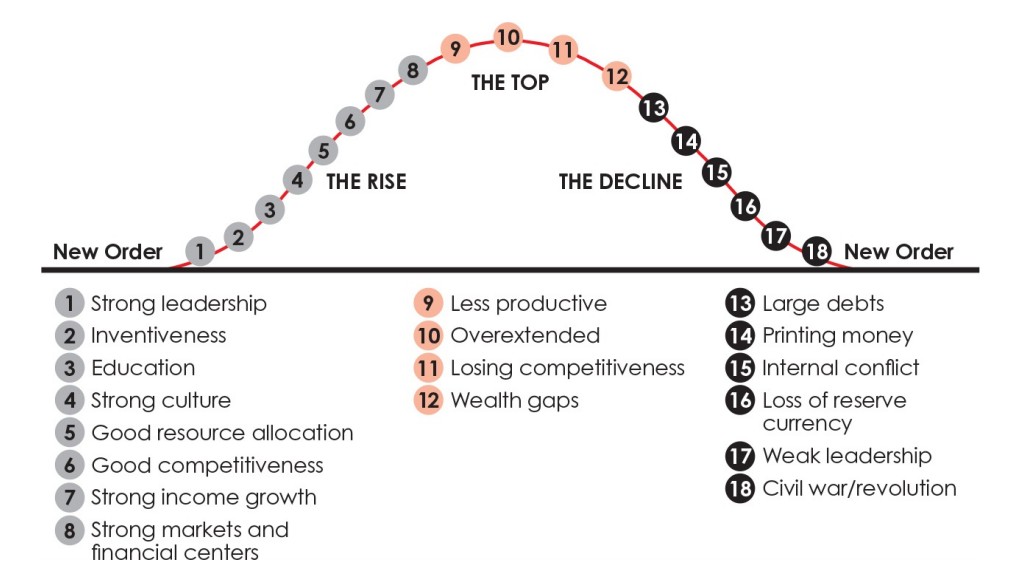
-
Prosperous Building Periods
- Conditions: Low debt, narrow social divides, social cooperation, strong institutions, and global peace.
- Outcomes: Rising productivity, innovation, wealth, and global leadership.
- Risk: These conditions tend to overextend, sowing seeds of decline.
-
Destructive Restructuring Periods
- Conditions: High debt, wide wealth and value gaps, social conflict, declining institutions, and rising external threats.
- Outcomes: Depressions, revolutions, wars, and eventual systemic collapse.
- Result: Establishment of a new internal and global order that restarts the cycle.
Mechanics and Predictability
-
Cause-Effect Logic: Each phase arises from the consequences of the last, making the sequence largely predictable in terms of direction, though not in timing.
-
Health Index Concept: A country’s position in the cycle can be assessed through a composite index of structural indicators (e.g., debt, education, inequality).
- Green = Strength → Likely prosperity ahead.
- Red = Weakness → Likely instability or decline ahead.
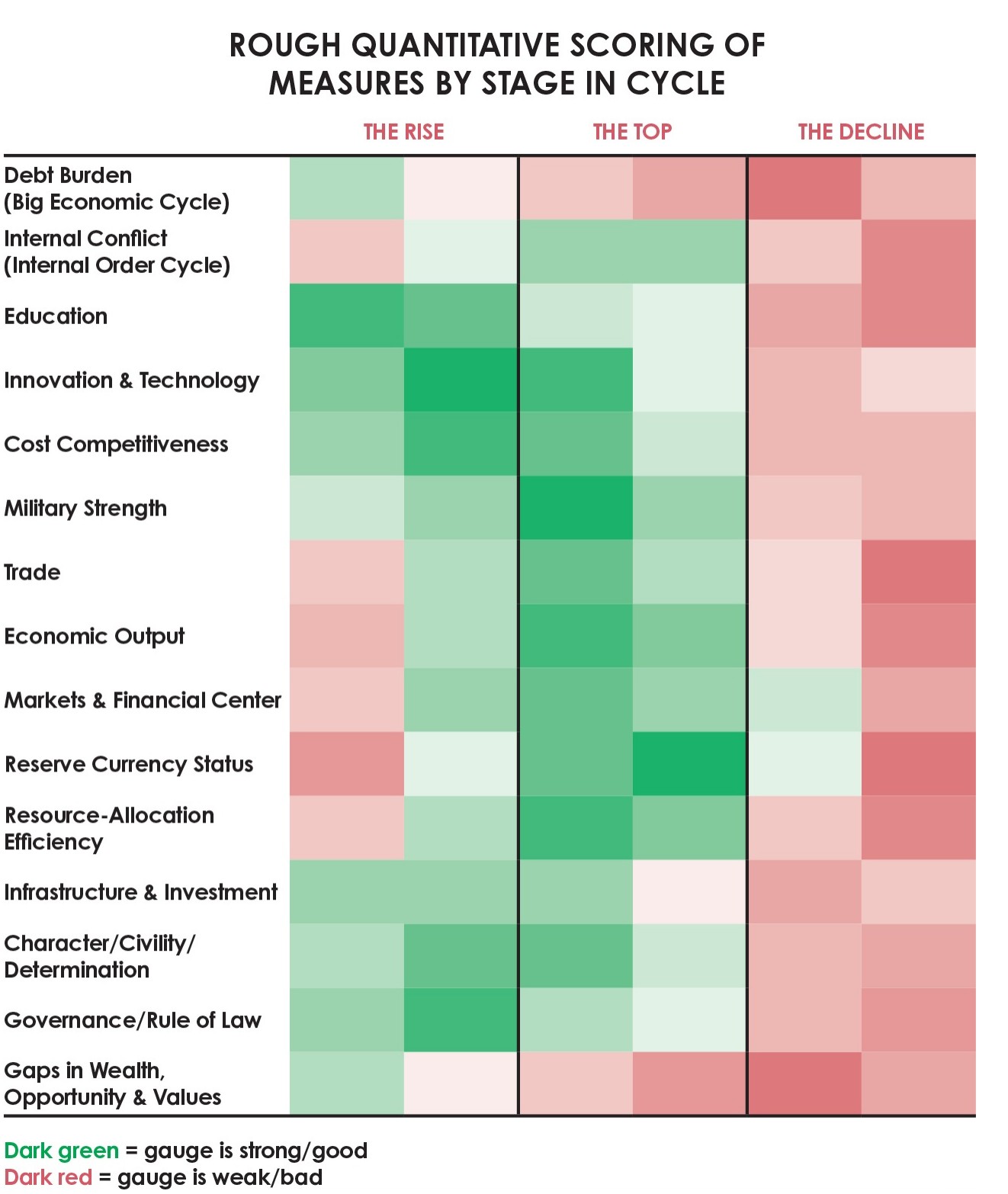
Mutual Reinforcement
-
Positive and negative dynamics reinforce one another (e.g., education boosts innovation, wealth gaps fuel unrest).
-
These interactions can converge into "perfect storms" involving:
- Debt crises
- Internal revolutions
- External wars
- Currency collapses
- Shifts in the world order
Historical Case Patterns
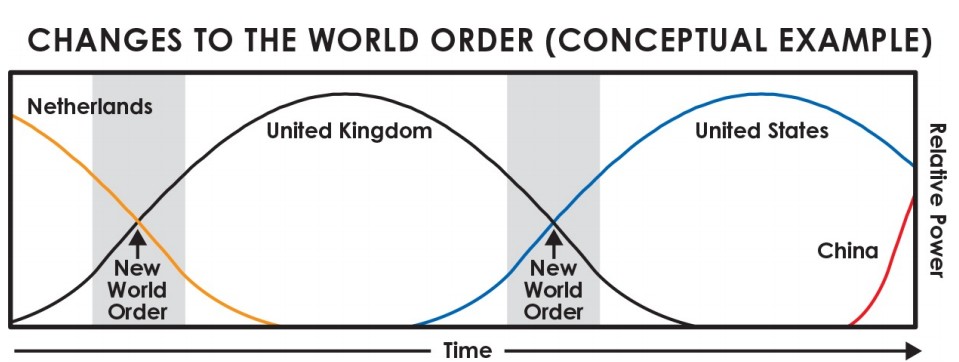
-
Dutch → British Transition
- Debt crisis → Revolution → War → Currency failure → New global leadership
-
British → American Transition
- Same pattern of systemic upheaval and realignment
Timeframes
- Destructive phases: 10–20 years (often shaded in historical cycle charts).
- Peaceful, prosperous phases: 40–80 years.
Conclusion
- Although the details vary, the overarching pattern of rise, top, decline, and reset remains consistent across history.
- The ability to measure and recognize these phases helps anticipate future transitions.
We are currently near the end of a historical Big Cycle, with systemic stresses indicating an approaching transition from the existing U.S.-led global order to a new one.
Current Context in Historical Terms
-
Post-1945 World Order Origins
-
Created after the 1930–45 destruction/restructuring phase.
-
Anchored by U.S. dominance in:
- Wealth (2/3 of global gold reserves),
- Economic output (about 50% of world production),
- Military strength (nuclear monopoly and strongest conventional forces).
-
Institutions: Bretton Woods system, UN (New York), World Bank and IMF (Washington, DC).
-
-
2020s: Signs of Systemic Strain
- Economic: High debt levels and ineffective conventional monetary policy.
- Political: Fragmented governments using fiscal stimulus financed by borrowing and central bank money printing.
- Social: Growing wealth and values gaps.
- Geopolitical: Rising power (e.g., China) challenging the dominant power (U.S.) across multiple domains.
Additional Stressors
- Pandemic: Exacerbates existing vulnerabilities and accelerates economic and political pressures.
Forward Outlook
-
Technological Optimism
- Human and artificial intelligence advancements offer solutions to current challenges.
- Potential for a new, different phase of prosperity if cooperation prevails.
-
Inevitable Upheaval
- Radical and traumatic changes are expected for many, consistent with the historical pattern of destructive-to-constructive transitions.
Final Reflection
- The current moment fits squarely within the cyclical framework previously outlined: a late-stage empire facing compounding internal and external pressures, poised for reordering.