ch2.the_determinants
Ch 2. The Determinants
Intro
The author has developed a dynamic, evolving model—based on recurring historical cause-effect relationships—that helps explain the rise and fall of empires and informs his decision-making in global macro investing.
Main Objectives of This Chapter
-
Deepen the Big Cycle Framework
- Move beyond the simplified version in the previous chapter to a more detailed, practical explanation.
-
Introduce the Modeling Methodology
- Show how historical patterns are turned into a usable decision-making tool through observation, backtesting, and computational modeling.
Key Concepts
-
History as a Rhyming, Evolving System
- Historical events repeat in pattern, not in precise form, because the causes are timeless but the context evolves.
- Studying diverse cases across time clarifies recurring dynamics.
-
The World as a Perpetual-Motion Machine
- History unfolds through ongoing, interacting cause-effect cycles.
- These cycles can be observed, measured, and modeled for practical use.
-
Modeling Process
- Observe historical events and derive principles.
- Backtest principles against historical data.
- Code these principles into algorithms.
- Use the model in real-world decisions (like global investing).
- Refine continuously through reflection and experience.
-
Human–Machine Partnership Analogy
-
Like a chess player paired with a computer:
- The human brings creativity and context.
- The machine brings speed, data processing, and pattern recognition.
-
This synergy helps navigate complexity with less emotional bias.
-
A mental model of historical cycles—a perpetual-motion machine—by analyzing the causal relationships between key determinants and their effects across generations, with the aim of anticipating the rise and decline of empires.
Core Principles of the Model
-
History as a Predictable, Cyclical Process
-
Countries and empires evolve in patterns akin to human life cycles.
-
Generational transfers of values, assets, and liabilities create long-term dynamics.
-
These dynamics are shaped by systems of governance, called:
- Internal orders (within countries),
- External orders (between countries),
- World orders (global systems).
-
-
Cause-Effect Framework
- Events are outcomes of identifiable, interacting determinants.
- Understanding these cause-effect relationships allows for anticipation of future shifts.
- Determinants and their effects are recursive—effects become new determinants over time.
Modeling Philosophy
-
Focus on Underlying Forces, Not Just Current Conditions
- Most people focus on present structures; the author emphasizes timeless forces driving change.
- Anticipating change requires understanding the system’s mechanics, not just its current state.
-
Predestined Logic (with Realistic Limits)
- Belief: If all causal dynamics could be captured, the future would be fully predictable.
- Reality: The model will never be perfect, but a crude version still offers strategic advantage.
Analytical Approach
-
Mixed Methodology
- Quantitative: Measures and tracks conditions to objectively assess cause-effect links.
- Qualitative: Interprets dynamics that can’t be numerically measured.
-
Historical Case Analysis
-
Studies numerous historical examples to correlate determinants (e.g., debt levels, monetary policy, social gaps) with effects (e.g., crises, wars, transitions).
-
Identifies recurring patterns, especially when key cyclical forces converge:
- Excess debt + money printing,
- Internal division,
- External power challenges.
-
Structural Dynamics
- Determinants → Effects → New Determinants → New Effects (ongoing feedback loop).
- These elements interact like matter and energy—interchangeable and generative.
Goal
- To continually refine an evolving model that aids strategic decision-making by simulating how complex historical forces interact over time.
The rise and fall of empires can be understood through a structured model built on interacting cycles and quantifiable determinants, which together help assess where a country stands in its life cycle.
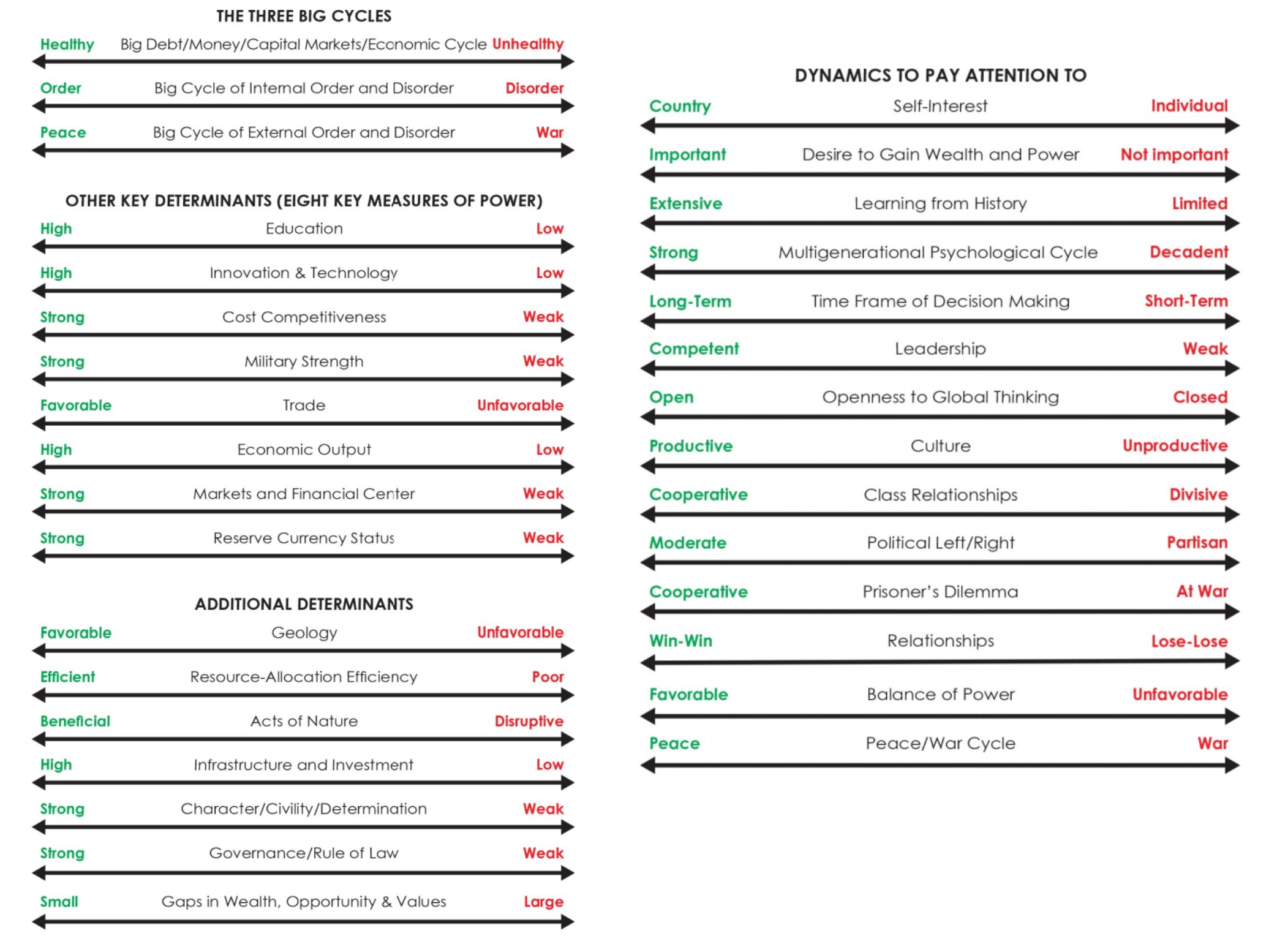
Key Frameworks and Components
I. The “Big Three” Cycles
-
Financial Cycle
- Capital markets: debt accumulation, credit availability, monetary policy.
-
Internal Order Cycle
- Domestic cooperation vs. conflict, especially over wealth and values.
-
External Order Cycle
- International competitiveness and conflict among rising and declining powers.
Insight: A country is strongest when all three cycles are in a good phase; weakest when all are in decline.
II. The “Big Five” Determinants
- In addition to the Big Three cycles:
-
Innovation & Technology
- Ability to solve problems and improve systems.
-
Acts of Nature
- Droughts, floods, diseases—significant historical disruptors.
III. The “Eight Powers”
Previously identified core indicators of national strength:
- Education
- Competitiveness
- Innovation and technology
- Economic output
- Share of world trade
- Military strength
- Financial center strength
- Reserve currency status
These rise and fall cyclically, reinforcing each other within the broader Big Cycle.
IV. Full List: “The 18 Determinants”
-
Includes additional elements such as:
- Geography/geology
- Rule of law
- Infrastructure
-
Some determinants are aggregated into broader indicators, others influence dynamics indirectly.
Practical Applications
-
Quantification System
- Countries can be scored (e.g., 1–10) across determinants to estimate relative position in the Big Cycle.
- This provides a probability-based view of whether a nation is rising or declining.
-
Computer-Assisted Modeling
- The model is aided by computational systems to track, evaluate, and forecast based on quantifiable indicators and qualitative dynamics.
Dynamics and Interactions
-
Determinants are interconnected, often reinforcing each other in virtuous or vicious cycles.
- Example: Strong education → more innovation → higher productivity → greater wealth and military strength → global reserve currency.
-
Some influences (e.g., leadership quality, human nature) are non-quantifiable but essential.
Model Philosophy
- This is a simplified but useful model.
- It’s intentionally open to revision, critique, and refinement through shared inquiry and practical testing.
The forces shaping a country’s trajectory can be grouped into two primary categories of determinants—inherited and human capital—each influencing how nations respond to circumstances and evolve over time.
Two Major Categories of Determinants
1. Inherited Determinants
-
Definition: Circumstances a country is born into and cannot change easily.
-
Examples:
- Geography: Access to oceans, arable land, defensible borders.
- Geology: Natural resources like minerals, oil, and water.
- Acts of Nature: Weather patterns, natural disasters, and pandemics.
These set the foundational constraints or advantages for national development.
2. Human Capital Determinants
-
Definition: The behaviors, values, and strategies of people within a country.
-
Drivers:
- Human Nature: Universal traits (e.g., short-termism, group loyalty).
- Culture: Varying societal norms and institutional practices.
-
Scope:
- Apply across all scales—individuals, organizations, governments, and empires.
These influence how effectively societies use their inherited conditions and navigate external challenges.
Inherited determinants—conditions a country is born with—play a foundational role in shaping its long-term trajectory, though their influence varies by type and over time.
Categories of Inherited Determinants
1. Geography
-
Influence: Shapes national cohesion, defensibility, and developmental strategy.
-
Examples:
- U.S. and China: Natural borders (oceans, mountains) promote unity and protection.
- Europe: Fragmented terrain fosters cultural and political division.
2. Geology
-
Influence: Access to natural resources (minerals, fossil fuels, arable land).
-
Caveats:
- Resource value declines over time due to technological change and depletion.
- Overreliance on commodities makes economies vulnerable (e.g., oil-dependent nations).
3. Acts of Nature
-
Influence: Sudden, powerful stressors that can surpass even wars in historical impact.
-
Examples:
- Pandemics (e.g., Black Death, smallpox).
- Climate disasters (e.g., floods, droughts) causing famines and social upheaval.
4. Genealogy
-
Influence: Genetic variation plays a minor role in national outcomes.
-
Note:
- While genetics affects individual behavior to some extent, cultural, institutional, and environmental factors are far more significant at the population level.
Human capital determinants—the behaviors, values, and capabilities of a population—are the most important long-term drivers of a country’s success or decline, often surpassing inherited assets.
I. What Is Human Capital?
-
Definition: Productive qualities of people that generate more value than they consume.
-
Ideal State: "Self-sufficient plus"—a condition where people, companies, or nations earn more than they spend.
-
Key Inputs:
- Education
- Work ethic
- Cooperation
- Cultural norms
- Leadership training
Insight: Human capital is renewable and can grow indefinitely, unlike finite natural resources.
II. Historical Examples of Strong Human Capital
- Individuals: Elon Musk, Steve Jobs, Bill Gates.
- Nations: Netherlands, England, Switzerland, Singapore.
III. The Most Important Human Nature Determinants
-
Self-Interest
- Most powerful human motivator.
- Societies differ based on what level (individual, family, national) self-interest is prioritized.
-
Pursuit of Wealth and Power
- A universal driver, though valued differently across cultures.
- Long-term sustainability requires balanced earning and spending.
-
Capital Markets Development
- Ability to save, invest, and mobilize capital is critical to national success.
-
Historical Awareness
- Societies that understand long-term historical patterns are better positioned for resilience.
- Example: China's strong historical consciousness.
-
Multigenerational Psychological Cycle
- Each generation’s experiences shape their outlook and behaviors.
- Without strong human capital maintenance, societies risk repeating cycles of rise and decline (“shirtsleeves to shirtsleeves”).
-
Short-Term vs. Long-Term Orientation
- Societies (and governments) that favor short-term gratification weaken themselves over time.
- Drives debt cycles and political dysfunction.
-
Inventiveness
- Humanity’s greatest asset—enables adaptation, productivity growth, and long-term prosperity.
- Unevenly distributed across societies and eras.
Several critical determinants of national success or failure are shaped primarily by culture, particularly how societies think, interact, and lead themselves. These influence how countries engage with the world and evolve over time.
12. Culture
-
Definition: Collective norms and principles about how people relate to reality and to one another.
-
Origins:
- Shaped by foundational thinkers, religions, philosophies, and texts (e.g., Confucius, Buddha, Plato; the Bible, Quran, Analects, etc.).
-
Function:
- Directs both formal systems (laws, governance) and informal social behaviors.
-
Impact:
- Acts as a society’s operating system—determining values, cooperation, adaptability, and resilience.
13. Openness to Global Thinking
-
Definition: A society’s willingness to learn from and engage with the broader world.
-
Benefits:
- Access to best practices, competition, innovation.
-
Risks of Isolation:
- Technological and intellectual stagnation.
- Historical examples of decline due to self-imposed isolation: late Tang/Ming China, Edo Japan, early PRC.
-
Insight:
- A leading indicator of whether a society will progress or fall behind.
14. Leadership
-
Definition: The influence of key individuals in determining national outcomes.
-
Analogy: Leadership is like playing a high-stakes game (chess or Go)—some players consistently make superior moves.
-
Historical Pattern:
- A few hundred leaders per generation (in government, science, commerce, arts, etc.) significantly alter the trajectory of societies.
-
Implication:
- Studying leaders’ decisions and consequences enhances understanding of how history unfolds and how cycles progress.
How individuals and groups interact—both within and between countries—creates powerful social and political dynamics that can drive harmony or conflict, prosperity or collapse. These interactions shape the trajectory of nations and their place in the world order.
Determinants Shaped by Intergroup Interactions
15. Wealth Gaps
- Effect: Widening disparities increase societal conflict, especially in downturns.
16. Values Gaps
- Effect: Conflicting beliefs (e.g., religious, ideological) exacerbate tribalism and reduce societal cohesion during stress.
17. Class Struggles
- Effect: Societies stratify into distinct social groups. Harmony early in cycles gives way to hostility as conditions deteriorate.
18. Political Left/Right Cycle
- Effect: Regular swings in political ideologies influence how wealth and power are distributed. These cycles are typically triggered by economic and class stresses.
Cooperative vs. Adversarial Dynamics
19. The Prisoner’s Dilemma
- Insight: Even rational actors may choose conflict over cooperation unless trust and safeguards are established.
- Solution: Interdependence and mutually assured consequences for betrayal reduce conflict risk.
20. Win-Win vs. Lose-Lose Relationships
- Effect: Societies and countries must choose the nature of their engagements—mutual benefit or mutual destruction.
- Caveat: Not all differences can be reconciled peacefully; conflict may be inevitable in some cases.
Power Dynamics and Military Force
21. Balance of Power Cycle
- Effect: Constant struggle for relative dominance—internally (e.g., political factions) and externally (e.g., nations).
- Cultural Variation: Played differently across cultures (e.g., chess in the West, Go in the East), but with the same goal: power consolidation.
22. Military Strength and the Peace/War Cycle
- Effect: Hard power influences outcomes through deterrence or conflict.
- Limitation: Lack of global enforcement mechanisms means disputes often resolve through force, continuing the cycle of war and peace.
All determinants—whether inherited, cultural, or rooted in human interaction—combine to shape the internal orders (within countries) and external orders (between countries), and their evolution over time. These shifts follow logical, interconnected cause/effect patterns that propel change in a cyclical, self-reinforcing process.
How the Determinants Function Collectively
1. Systems as Evolving Constructs
-
Internal and external orders are not static; they evolve through:
- Interactions among existing conditions
- Forces acting on these conditions
- Resulting new conditions that perpetuate the cycle
2. Predictability through Circumstances
- While the future is not fully knowable, understanding a system’s current state and the logic of how similar systems have evolved provides insight into likely future outcomes.
- Every set of current conditions offers a limited set of probable trajectories.
3. Political Systems as Case Studies
-
Example: The U.S. electoral system’s current function is shaped by:
- Historical development of constitutional democracy
- Cultural and political evolution over generations
- The present-day electorate’s values and behaviors
4. Implication of Changing Generations
- Different generations produce different outcomes because they are products of distinct conditions, shaped by evolving cycles.
- Lack of historical perspective blinds societies to how systems shift over time.
Strategic Takeaway
-
By comprehending how the perpetual-motion machine of societal evolution works, one can:
- Better anticipate system transformations (e.g., shifts in capitalism, democracy, autocracy)
- Forecast changes in power structures and wealth distribution
- Make wiser decisions as individuals, investors, or national leaders
DETERMINANTS ADDENDUM
Understanding self-interest and the pursuit of wealth and power reveals how internal and external societal structures evolve and often fragment or coalesce over time. These dynamics are core to the rise and fall of internal and world orders.
5. Self-Interest and Group Identity
Core Insight
- Self-interest motivates behavior, but the definition of “self” varies—individual, family, tribe, state, nation, empire, humanity.
Key Dynamics
-
People protect what they identify with most.
-
Historical shifts show changing dominant identity units:
- E.g., tribes → states → nations → empires → regional unions (e.g., EU) or fragmentation (e.g., USSR).
-
Modern trend: Movement from globalism toward nationalism and intranational division (e.g., U.S. state-level divergence).
Implications
- A society’s cohesion and its willingness to sacrifice for larger shared identities affect its strength.
- Monitoring shifts in identity cohesion indicates potential changes in political and social stability.
6. The Drive for Wealth and Power
Core Definitions
- Wealth = Buying Power: Not just money, but the capacity to acquire valuable goods/services.
- Real Wealth ≠ Financial Wealth: Real wealth provides intrinsic utility; financial wealth is a claim on future purchasing power.
Wealth Fundamentals
- Productivity is the Source: Sustained wealth comes from ongoing productivity, not static assets or redistribution.
- Investment over Consumption: Societies investing in infrastructure and innovation tend to become and stay wealthier.
Wealth-Power Nexus
- Wealth enables acquisition of power (political, military, social).
- Power protects and can expand wealth (as in historical imperial expansions).
- Symbiosis between wealth holders and rulers defines political orders.
Decline Pattern
- When spending outpaces income, individuals, societies, and empires deteriorate.
- Societies with more self-sufficient individuals are generally more resilient.
Strategic Takeaway
- Monitoring the dominant level of identity and the balance of productivity vs. consumption provides early signals about a society’s direction—toward cohesion and strength or fragmentation and decline.
The psychological mindset of a population evolves over multiple generations in tandem with economic conditions, driving the cyclical rise and fall of nations and empires.
Cycle Overview: Five Stages of National Mindset and Economic Health
Stage 1: Poor and Aware of It ("Early-Stage Emerging Countries")
- Psychology: Frugal, hardworking, low-debt mindset.
- Economy: Subsistence living; minimal credit; potential hindered by poverty.
- Outcomes: Growth is gradual and driven by necessity; savings begin to accumulate.
Stage 2: Rich but Still Think Poor ("Late-Stage Emerging Countries")
- Psychology: Financial caution continues; work ethic remains high.
- Economy: High productivity and income growth; efficient investment; low debt.
- Outcomes: Rapid development; strong competitiveness and rising global influence.
Stage 3: Rich and Aware of It ("Peak Health Countries")
- Psychology: Comfort-focused; consumerism grows; new generation unaware of past hardships.
- Economy: Slowing productivity gains; higher labor costs; flourishing arts and leisure.
- Outcomes: Global power status; military and cultural influence expand; foundation of global empires.
Stage 4: Poorer but Still Think Rich ("Early Declining Countries")
- Psychology: Complacency and denial about decline; reluctance to adjust.
- Economy: Rising debt, falling savings, inefficient investment, aging infrastructure.
- Outcomes: Appear wealthy while structural weaknesses grow; bubbles and imbalances emerge.
Stage 5: Poor and Aware of It Again ("Clearly Declined Countries")
- Psychology: Reality catches up; painful adjustment begins.
- Economy: Asset deflation, deleveraging, weak currency, increased government intervention.
- Outcomes: Decline in global status; long-term stagnation; difficult and slow recovery, if any.
Strategic Implication
- The psychological and economic state of a country are tightly interlinked across generations.
- Recognizing a nation's stage in this cycle offers predictive insight into its future trajectory, policy responses, and global role.
The capacity for innovation is the single most powerful and consistent force driving human progress, productivity, and national success, far outweighing any individual problem faced by societies.
Fundamental Premises
- Inventiveness Outpaces Problems: Human ability to solve problems consistently exceeds the scale of the problems themselves.
- Progress Is Asymmetrical: Unlike economic cycles, knowledge tends to build cumulatively—with upward spurts during boom periods and sputters during downturns, not true reversals.
When Innovation Flourishes
- During the peaceful and prosperous phases of the Big Cycle.
- When systems that support innovation—such as education, freedom of thought, capital availability, and cultural openness—are functioning well.
- In Renaissance periods, characterized by widespread creativity across science, art, governance, and social thought.
How Innovation Drives Success
- Increased Productivity: More output per worker raises cost competitiveness and national wealth.
- Improved Living Standards: Advances in technology and automation replace manual labor and reduce hardship.
- Greater Interconnectedness: Technology enhances global linkages and information exchange.
- Enhanced Decision-Making: Computerization supports faster, more rational choices—though it brings risks too.
The Innovation Engine
- Innovation: Generating valuable new ideas and technologies.
- Commercial Spirit: Motivating individuals and firms to bring innovations to market.
- Capital Markets: Efficient systems to fund, scale, and reward successful innovations.
These three together result in:
Great Productivity Gains → Increased Wealth → Increased National Power
Strategic Insight
- Societies that foster inventiveness and align incentives to support it (via markets, education, and openness) sustain their ascent.
- Measuring innovation capacity and commercial incentives is essential for forecasting a country’s trajectory.
Class struggles—conflicts over wealth and power between elite and non-elite groups—are fundamental and recurring drivers of social, economic, and political evolution throughout history.
Foundational Dynamics
- Persistent Inequality: A small elite class consistently controls the majority of wealth and power.
- Elites Maintain the Order: Those benefiting from the current system cooperate to preserve it, often forming alliances between political and economic power holders.
- Struggle Intensifies in Crisis: When economic or social conditions worsen, tensions escalate, often leading to revolutions or civil wars.
Historical Pattern: The Big Cycle
- Wealth Creation: Periods of peace and productivity increase overall wealth—but unequally.
- Elite Accumulation: A small group gains disproportionate control of resources and power.
- Overextension & Decline: Elites overreach; crises (economic, natural, military) disproportionately hurt the lower classes.
- Conflict & Upheaval: Heightened inequality leads to conflict—either through reform or violent revolution.
- New Order Emerges: A new elite structure forms, and the cycle begins again.
Institutional Evolution Through Class Conflict
- Power-sharing among monarchy, nobility, clergy, and commoners gradually gave way to capitalist-democratic or autocratic arrangements.
- Key transformations (e.g., Magna Carta, French Revolution) occurred when subordinate classes forced systemic change.
- The structure of governance evolved similarly across civilizations, shaped by class-driven power struggles—both peaceful (via negotiation) and violent (via war).
Modern-Day Class Dynamics
- Class Identity Still Matters: Despite ideals like the "melting pot" in the U.S., social and political affiliations often align with class divisions.
- Class = Cluster of Attributes: Wealth, ideology, race, religion, gender, location, etc., shape how people group and who they see as allies or adversaries.
- Political Elites & Capitalists Dominate: Today, those who control money (capitalists) and political decision-making (elected or appointed leaders) are the dominant elites.
- Under Pressure: These modern elites face rising pressure for inclusion and equality, particularly from tech-disrupted and historically marginalized groups.
Strategic Insights
- Class Conflict Forecasts Political Change: Watching which groups gain or lose influence helps predict systemic transformation.
- Inclusivity and Meritocracy Yield Stability: Societies that embrace broad participation based on ability—not privilege—tend to perform better over time.
- Tensions Between Classes Are Cyclical: The peaceful or violent resolution of these tensions determines the trajectory of internal orders.
The political left/right cycle reflects deep ideological and self-interest divides that influence how societies manage wealth, opportunity, and power. These divisions oscillate in intensity and impact national stability and economic systems.
Foundational Perspectives
Rightist/Capitalist View
-
Moral Values: Self-reliance, hard work, individualism, merit-based rewards.
-
Economic Beliefs:
- Private sector > public sector for efficiency.
- Wealth creation through productivity is virtuous.
- Billionaires and entrepreneurs are seen as societal benefactors.
-
Criticisms:
- Often ignore broader systemic inequities.
- Tend to overlook societal investments like public education unless profit-driven.
- See welfare and social support as disincentives to productivity.
Leftist/Socialist View
-
Moral Values: Collective responsibility, equity, support for the disadvantaged.
-
Economic Beliefs:
- Government intervention ensures fairness and opportunity.
- Essential workers are undervalued under capitalism.
- Wealth should be more evenly distributed.
-
Criticisms:
- Less effective at incentivizing innovation and growing the economic pie.
- Often inefficient in resource allocation due to political motivations.
Systemic Dynamics
- Inherent Tension: These ideologies are not just policy differences—they reflect competing worldviews on fairness, productivity, and the role of government.
- Cycle of Dominance: Societies swing between left and right as public sentiment reacts to perceived excesses or failures of the current system.
- Economic Drivers: Booms often favor the right (growth, wealth accumulation), while busts or inequality spur leftist momentum (redistribution, reform).
Balanced Challenge
-
Ideal Policy Goal: Blend capitalism’s productivity with socialism’s equity.
-
Main Tension for Policymakers:
- Encourage innovation and investment.
- Reduce inequality and maintain social cohesion.
-
Instability Risk: Failure to balance leads to political polarization, cycles of unrest, and potential regime changes.
The balance of power dynamic drives cyclical shifts in domestic and global orders, cycling through phases of alliance, conflict, resolution, and eventual systemic renewal or collapse.
Key Dynamics and Phases
-
Formation of Alliances
- Power asymmetries prompt weaker factions to form coalitions to counter stronger ones.
- These alliances often span divergent interests unified by shared opposition (“the enemy of my enemy is my friend”).
- Applies across scales—from office politics to global geopolitics.
- Globalization has expanded the geographic scope of such alliances (e.g., world wars).
-
War to Determine Winners and Losers
- Major conflicts emerge when both sides have near-equal power and existential disagreements.
- Asymmetrical power usually discourages full-scale war due to predictable outcomes.
- Violence can be avoided if shared rules (e.g., constitutions, international norms) are respected.
- Without rules or adherence, conflicts become brutal and potentially regime-changing.
-
Infighting Among Winners
-
Post-victory, coalitions often fracture as former allies vie for control.
-
Historical examples include:
- France: Reign of Terror after Revolution.
- Soviet Union: Red Terror post-revolution.
- China: Communist-Nationalist civil war after WWII.
-
Systems shape outcomes: Democracies tolerate opposition; autocracies suppress or eliminate it.
-
-
Peace and Prosperity Phase
- Follows power consolidation; marked by stability, recovery, and rebuilding.
- Often considered a “golden age” due to reduced external/internal conflict.
- Eventually leads to complacency and structural imbalances (e.g., wealth gaps, over-indebtedness).
-
Rising Conflict and Order Breakdown
- Inequities and financial imbalances grow, eroding the legitimacy of existing systems.
- Public frustration and institutional fragility increase the likelihood of revolutionary change—domestically or globally.
- A new cycle begins as existing orders are challenged or overthrown.
Conceptual Takeaway
The Big Balance of Power Cycle is a recurring, systemic process shaping the rise and fall of orders through cooperation, conflict, consolidation, and eventual reset.